
.svg)
Where to Go in 2026: Our Expert Picks
Our 2026 picks: Uganda, Kenya, Australia and Zambia, plus Guyana and Northern Albania. Places that cap visitor numbers and still feel wild if you plan them well.
Discover
If you have a week in Zimbabwe, the simplest good trip is three or four nights in Hwange National Park and two at Victoria Falls. They are close together, the flight between them is short, and they balance each other well: Hwange is about elephants at waterholes, and the falls are about the river and the gorge. Here is how they fit together, where to stay and when to go.
Hwange is Zimbabwe's largest national park, about 14,600 km² of Kalahari sand, teak woodland and open grassland in the north-west of the country. Because it sits on sand, there is little permanent surface water. Many pans are kept topped up through the dry season with water pumped from underground, and in the private concessions the camps help run solar-hybrid pumps on their own pans. That water is what keeps the animals in the park when the bush dries out.
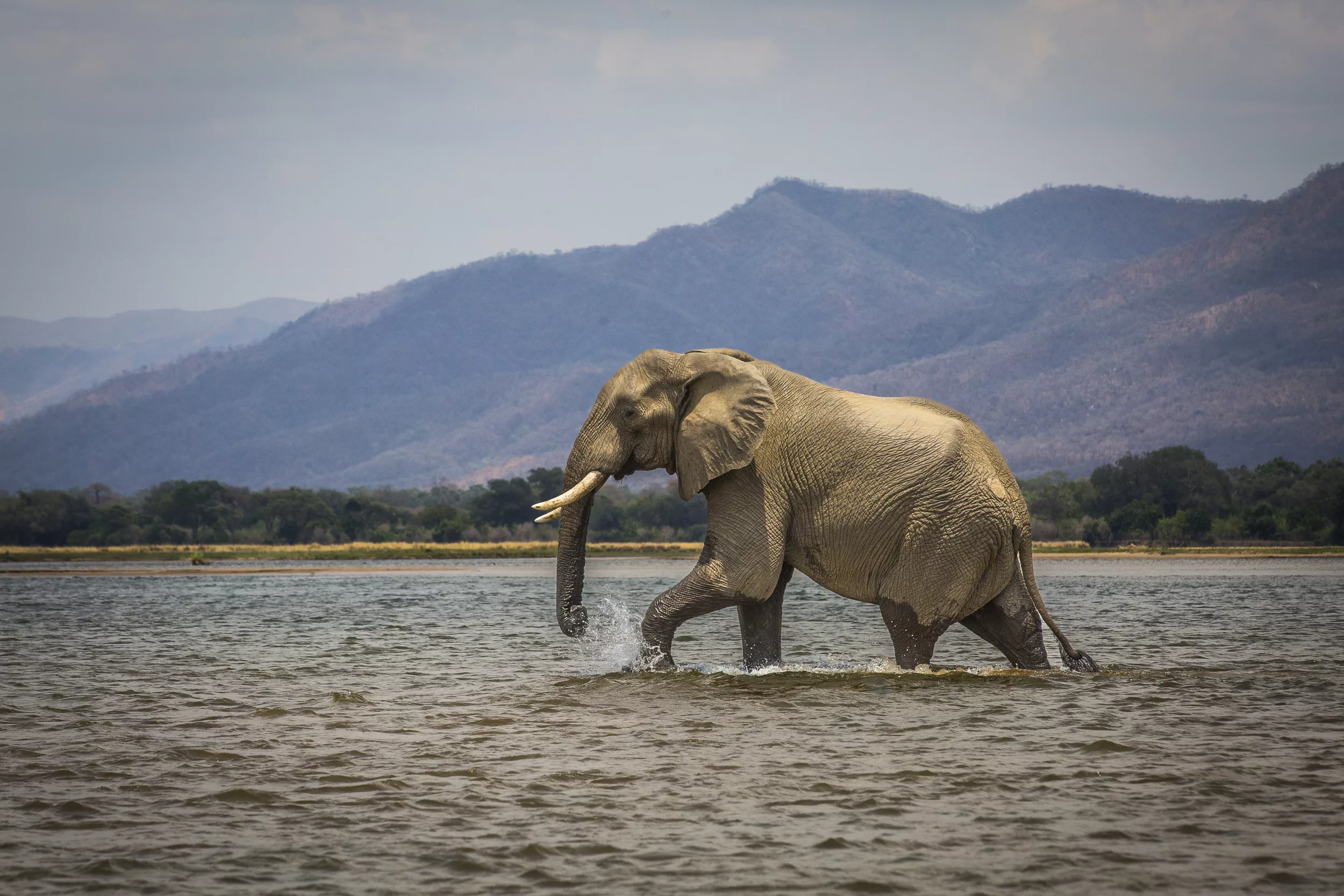
Elephants are the main event. In the dry months breeding herds walk in from the woodland to drink, often one family after another through the afternoon. The park has more than 100 mammal species, including sable and roan antelope, giraffe, zebra, lion, leopard, cheetah, spotted hyena and African wild dog, and over 400 bird species. Game drives fill the mornings and afternoons, but the waterholes set Hwange apart. Several camps have sunken or log-pile hides at the water's edge, where you sit at eye level with elephants drinking a few meters away.
Hwange works in two quite different ways. The public park has three main entrances, at Main Camp, Sinamatella and Robins, and Main Camp is the closest to the Victoria Falls road. Self-drivers, day visitors and tour vehicles share the same roads, and at popular waterholes you can expect company.
The camps we use are in the south-east, in the private Linkwasha and Makalolo concessions and in the Somalisa area along the Kennedy vlei line. These areas are quieter than the roads around Main Camp, every camp looks over its own waterhole, and the camps add things you cannot do on a day visit, such as ground-level hides, nights on sleep-out platforms and, at some camps, guided walks.
Three nights at one camp is a good stay. With four or five nights, split them between two camps, for example Linkwasha for the hide and Davison's for walking.
The dry season, from about June to October, is the classic time for Hwange. The bush thins out and wildlife gathers around the pans. Mornings in open vehicles are cold from June to August, and October is very hot. From December to March the rains spread the animals out, plains game have their young on the Ngamo Plains, migrant birds arrive and rates drop.
Victoria Falls runs on a different calendar. The Zambezi floods from about February to May and peaks around April, when the falls are at their loudest but the spray can hide much of the view. Flow is lowest around November. June to August gives you strong flow with clearer views, which also lines up with good game viewing in Hwange. Our guide to high and low water at Victoria Falls goes into more detail.
Most people fly. Light aircraft from Victoria Falls Airport reach the airstrips in south-eastern Hwange in roughly 40 minutes to an hour. For Somalisa you land at Manga airstrip and drive about 30 minutes to camp.
The road is an option but a long one. Main Camp is roughly 190 km from Victoria Falls, about two and a half hours by road. The private camps in the south-east are a good deal farther in, and a road transfer to them takes four hours or more, the last part on dirt roads through the park. For the remote camps, flying is close to essential. Luggage limits on the light aircraft are strict, so pack in a soft bag.
Victoria Falls is where the Zambezi drops about 108 meters into a narrow gorge along a front roughly 1,700 meters wide. The falls form the border between Zimbabwe and Zambia and have been a UNESCO World Heritage Site since 1989.
On the Zimbabwe side, a path runs along the far edge of the gorge with 16 numbered viewpoints. It starts at the statue of David Livingstone above Devil's Cataract, passes the Main Falls and a strip of rainforest kept wet by the spray, and ends at Danger Point, with a view of the Victoria Falls Bridge. Most of the falls face this side, so most people find it the better walk, and it keeps water for longer late in the year.
The Zambian side, in Mosi-oa-Tunya National Park, sees less of the falls and can dry up almost completely from about October to early December. Its draw in low water is Devil's Pool on the lip of the falls, usually open from about late August to early January. The two towns are linked by the Victoria Falls Bridge, and crossing means clearing both border posts, so check the visa rules for your passport.
The Victoria Falls Hotel has stood above the Second Gorge since 1904. It is a big, old-world hotel of about 161 rooms, and its terrace looks straight at the bridge and the spray. You can walk to the falls in about ten minutes, and high tea on Stanley's Terrace is a tradition.
Anantara Stanley & Livingstone Victoria Falls Hotel is the quieter choice: 16 suites in a private game reserve about 15 minutes' drive from the falls, with a waterhole view and a black rhino conservation experience in the Victoria Falls Private Game Reserve. It suits families and couples who prefer the bush to town.
Two nights covers the falls plus one or two extras, such as a helicopter flight over the gorge, a sunset cruise on the river above the falls or a zipline across the Batoka Gorge.
With a few more days, the easiest addition is water. Bumi Hills Safari Lodge sits on a ridge above Lake Kariba, next to Matusadona National Park. The lake runs for more than 220 km along the border, and days there mix boat cruises, catch-and-release tigerfishing, game drives and walks. From September 2026 the lodge also runs rhino activities in Matusadona. Flights from Victoria Falls take about 1 hour 40 minutes, and from Hwange about an hour and a half. Two or three nights is about right.
For more wildlife, add Mana Pools on the Zambezi for walking and canoeing. Our post on Mana Pools explains the camps and the season, and our ten-day Zimbabwe itinerary links Hwange, Mana Pools and Victoria Falls in one trip.
If you would like help planning Hwange and Victoria Falls around your dates, get in touch.
Every itinerary begins with a conversation. Tell us what you have in mind, and we’ll plan a trip around you.
Plan Your Trip


.svg)